
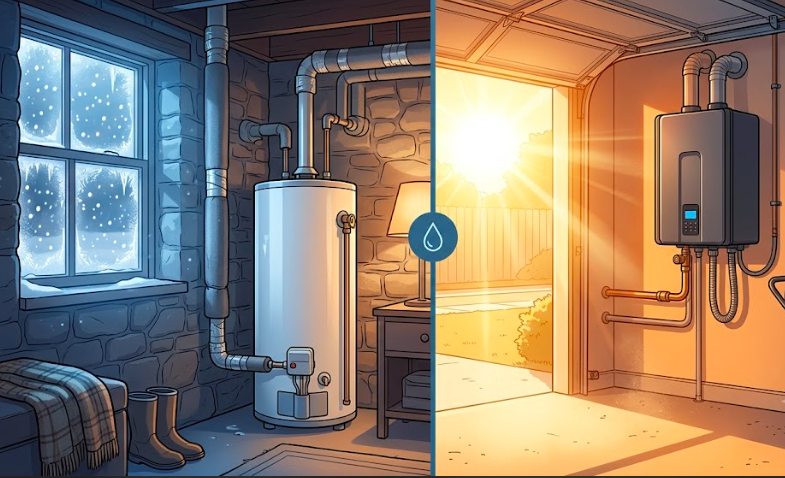
Your water heater is working harder than you think and your local climate is the reason.
Most homeowners assume a water heater lasts 8–12 years no matter where they live. But the truth is, where your home sits on the map has a massive impact on how quickly your system wears out, what problems it develops, and how often it needs professional attention.
Whether you’re bundling up through a Passaic, NJ winter or sweating through a Texas summer near Lake Travis, your water heater is constantly adapting to conditions outside your control. Understanding those conditions can save you hundreds sometimes thousands in unexpected repair bills.
In this guide, we break down exactly how climate stresses your water heater, region by region, so you know what to watch for and when to call a pro.
Why Climate Matters More Than Most Homeowners Realize
Your water heater’s job seems simple: heat cold water and keep it ready. But “cold water” in Passaic in February and “cold water” in Austin in July are two very different things.
Groundwater temperature in northern states like New Jersey can drop to 40°F or lower in winter. That means your water heater has to raise incoming water by 60°F or more just to hit a safe delivery temperature of 120°F. The harder it works, the faster internal components wear down.
In warmer states like Texas, groundwater stays closer to 65–75°F year-round. The heating demand is lower but the tradeoffs are different. Hard water, extreme outdoor temperatures affecting utility closets and garages, and the added strain of running HVAC systems simultaneously create their own category of wear and tear.
There is no single “easy” climate for a water heater. There are only different failure modes depending on where you live.
The New Jersey Challenge: Cold Winters, Sediment Buildup, and Frozen Risk
Here in Passaic County, water heaters face a unique set of stress factors that shorten lifespan if left unaddressed.
1. Cold Incoming Water = Constant Overwork
From November through March, the groundwater feeding your home can drop to near-freezing temperatures. Your water heater is designed for this, but running continuously at maximum output accelerates the breakdown of the heating element (in electric models) or the burner assembly (in gas models). If your system is already 7+ years old, this seasonal push can be what finally breaks it.
Signs of overwork in NJ winters: pilot light going out repeatedly, water taking longer to heat up, strange rumbling noises when the unit kicks on.
2. Hard Water and Sediment Accumulation
Much of North Jersey has moderately hard water. Minerals in the water supply primarily calcium and magnesium settle at the bottom of your tank over time. This layer of sediment acts as insulation between the burner and the water, forcing your system to burn more energy to achieve the same result. Left unchecked, it causes overheating, premature tank failure, and a distinctive “popping” or “rumbling” sound.
Annual sediment flushing is one of the simplest, most cost-effective maintenance tasks a Passaic homeowner can do. Most homeowners skip it entirely.
3. Freezing Pipes and Utility Room Exposure
In older Passaic homes, water heaters located in uninsulated basements or garages are exposed to temperature drops that affect not just the tank but the inlet and outlet pipes. Even a brief freeze can crack fittings and cause significant water damage before anyone notices.
Passaic Tip: If your water heater is in an unheated space, ask your plumber about pipe insulation sleeves and whether your unit needs additional protection before winter. At Leading Passaic Plumber, we do a quick winter-readiness check with every service call.
The Texas Challenge: Heat, Hard Water, and HVAC System Stress
Texas homeowners deal with a different kind of water heater stress one that’s less about cold and more about relentless heat, water quality, and the compound demands of year-round cooling systems.
1. Extreme Outdoor Heat Affects Utility Spaces
In areas like Lake Travis, Austin, and the Texas Hill Country, summer temperatures regularly exceed 100°F. Water heaters stored in garages or outdoor utility closets can be exposed to ambient temperatures that push internal components to their limits even when the unit isn’t actively heating. This is especially problematic for tankless water heaters, which have more sensitive electronics.
2. Texas Hard Water Is Among the Worst in the Country
Central Texas is notorious for some of the hardest water in the United States. High mineral content means sediment builds up faster than in most other regions. Tank-style water heaters in this area may need flushing every six months rather than annually. Scale buildup on heating elements is also a leading cause of premature failure in Texas electric water heaters.
3. Combined Plumbing and HVAC Load
In Texas, the relationship between your plumbing system and your HVAC system is closer than most homeowners realize. During summer months, air conditioning units run nearly continuously. When both systems are taxed simultaneously think running dishwashers, multiple showers, and the AC all at once the strain on your home’s overall utility infrastructure increases significantly.
This is why many Texas homeowners benefit from working with a service provider who understands both plumbing and HVAC systems together, not in isolation.
Texas Homeowner Resource: For residents in the Lake Travis and greater Austin area managing both water heater performance and HVAC efficiency, Allstate Plumbing Heat and Air Lake Travis offers integrated plumbing and heating/cooling services a practical option when you need both systems evaluated together. Addressing water heater and HVAC efficiency in the same visit can catch problems that single-system providers often miss.
Climate-by-Climate Maintenance Checklist
Wherever you live, consistent maintenance is the single best way to extend your water heater’s life. Here’s what that looks like broken down by climate type:
For Cold-Climate Homeowners (New Jersey, Northeast)
- Flush sediment annually: ideally before winter, when demand peaks
- Inspect the anode rod: every 2–3 years and replace when more than 50% depleted
- Check pipe insulation: around inlet/outlet pipes before the first freeze
- Test the pressure relief valve: at least once a year
- Lower thermostat to 120°F: to reduce unnecessary heating load (and scalding risk)
- Schedule an annual inspection: before November to catch anything that could fail under winter load
For Hot-Climate Homeowners (Texas, Southwest)
- Flush sediment every 6 months-due to high mineral content in the water
- Inspect the heating element annually-scale buildup is common and reduces efficiency
- Check utility closet or garage temperatures-add ventilation if ambient heat regularly exceeds 120°F
- Consider a water softener-to reduce mineral load on the tank and extend lifespan
- Evaluate tankless options-in Texas, on-demand systems often outperform traditional tanks in energy efficiency
- Don’t ignore HVAC interactions-combined system checks save money over separate service calls
When to Replace Instead of Repair: A Climate-Adjusted Guide
The standard rule is: if your water heater is over 10 years old and needs a major repair, replacement often makes more financial sense. But climate adjusts that math.
In New Jersey, where winters are hard and heating demand is high, a water heater that’s pushing 8–9 years and showing signs of sediment damage or element wear is unlikely to survive another full winter without a breakdown. Replacing before failure rather than during an emergency saves on both repair costs and the premium rates that come with emergency service calls.
In Texas, the harder water supply and summer heat exposure mean some systems fail earlier than the national average. A 7-year-old tank in a high-mineral area with inadequate maintenance may be at the same risk level as a 10-year-old tank elsewhere.
The bottom line: your water heater’s age matters less than its condition, and its condition is directly tied to where you live and how well it’s been maintained.
Tankless Water Heaters: A Climate-Smart Upgrade?
One question we get frequently at Leading Passaic Plumber: does switching to a tankless system make sense given our climate here in northern New Jersey?
The honest answer is: it depends on your household’s hot water usage pattern. Tankless units are extremely efficient at what they do they heat water on demand rather than maintaining a large stored volume. But in a home with high simultaneous demand (multiple showers, dishwashers, and laundry running at once), a single tankless unit can struggle to keep up.
That said, for smaller households or homes with staggered usage patterns, tankless installation in Passaic can cut water heating energy costs by 20–30% compared to a traditional tank. In climates with cold incoming water, choosing a unit with sufficient BTU output for your region is critical a unit sized for Texas won’t perform the same way in a New Jersey winter.
We always recommend a professional sizing consultation before any tankless installation. A unit that’s undersized for your climate and household is worse than no upgrade at all.
Final Takeaway: Your Climate Is Your Water Heater’s Biggest Variable
A water heater installed in Passaic, NJ will age differently than one installed in Lake Travis, TX. It will fail for different reasons, at different rates, and require different types of maintenance along the way. Understanding that isn’t just interesting it’s the foundation of actually getting 10–15 years out of a system that many homeowners wear out in seven.
The homeowners who treat water heater maintenance as seasonal the same way they think about furnace filters or gutter cleaning are the ones who avoid emergency cold showers, unexpected flooding, and the expense of replacing a system they could have extended for years.
Whether you’re in the middle of a New Jersey winter or bracing for a Texas summer, your water heater is doing its job. Make sure you’re doing yours.
Passaic Homeowner? Get a Free Water Heater Inspection
Our licensed team serves all of Passaic County same-day appointments available, no hidden fees.(833) 414-4877 — Call Now
Leave a Reply